
Ancient British spirituality refers to the land-based beliefs, ceremonial sites, seasonal observances, and sacred relationships with nature that shaped life in prehistoric and early Celtic Britain. While much remains uncertain, stone circles, burial mounds, and later accounts of Druidic tradition suggest that the peoples of the British Isles understood landscape, sky, ancestry, and ritual as deeply connected.
Across the hills, valleys, and coastlines of the British Isles lies a landscape shaped not only by geology and history, but by ancient ceremony and spiritual imagination.
Long before modern towns and cities emerged, these islands were home to communities who marked the seasons with gatherings, built monuments aligned with the movement of the sun, and treated particular places as spiritually significant. Stone circles, burial mounds, and ancient pathways still mark the countryside, reminding us that Britain once held a rich tradition of sacred relationship with land and season.
Today, many people recognise iconic sites such as Stonehenge, yet fewer are familiar with the wider sacred landscapes that once surrounded monuments like these. The traditions of ancient Britain were woven through cycles of nature, oral culture, ancestral memory, and reverence for forces larger than ordinary daily life.
Although much of this knowledge was transformed over centuries of conquest, religious change, and cultural loss, the land itself still carries traces of that heritage.
At Soul Revolution Festival, this theme offers a powerful invitation: to look again at the landscapes we thought we already knew, and to rediscover the deeper spiritual imagination once rooted within them.
A Land of Ancient Ceremonial Sites
The British Isles contain thousands of prehistoric monuments, including stone circles, chambered tombs, earthworks, henges, and standing stones. Many of these sites date to the Neolithic and Bronze Age, and archaeologists interpret them as places connected to gathering, ceremony, burial, remembrance, and seasonal observance.
While the exact beliefs of the communities who built them cannot always be known with certainty, the placement of many monuments suggests a careful relationship with both landscape and sky. Some were aligned with solstice sunrises or sunsets. Others were placed in visually striking positions that connected hills, valleys, waterways, and horizon lines as part of the wider ritual experience.
Rather than seeing these places as isolated ruins, it is often more accurate to understand them as parts of a wider British sacred landscape — networks of places where ancient communities may have marked time, honoured ancestors, and gathered in relationship with the living world.
Stone Circles of the Peak District
Among Britain’s lesser-known sacred sites are the stone circles of the Peak District, including Arbor Low and the Nine Ladies Stone Circle.
English Heritage describes Arbor Low as a major Neolithic henge monument in Derbyshire, with an earthen bank and ditch surrounding around 50 limestone slabs and a central stone cove. Nearby Gib Hill is a large burial mound, reinforcing the ceremonial importance of the wider site.
The Nine Ladies Stone Circle on Stanton Moor is an early Bronze Age site, part of a wider prehistoric complex of circles, standing stones, and cairns. Its folklore — including the story that the stones were once dancers turned to stone — reflects how mystery and sacred storytelling continued to gather around these places long after their original use was forgotten.
Archaeologists cannot say with certainty exactly how these circles were used. Even so, their setting, design, and relationship to nearby monuments strongly suggest communal and ceremonial significance. That uncertainty does not diminish their power. It may be part of why such sites still invite reflection today.
Stonehenge and the Sacred Landscape of Britain
The most famous prehistoric monument in Britain is, of course, Stonehenge.
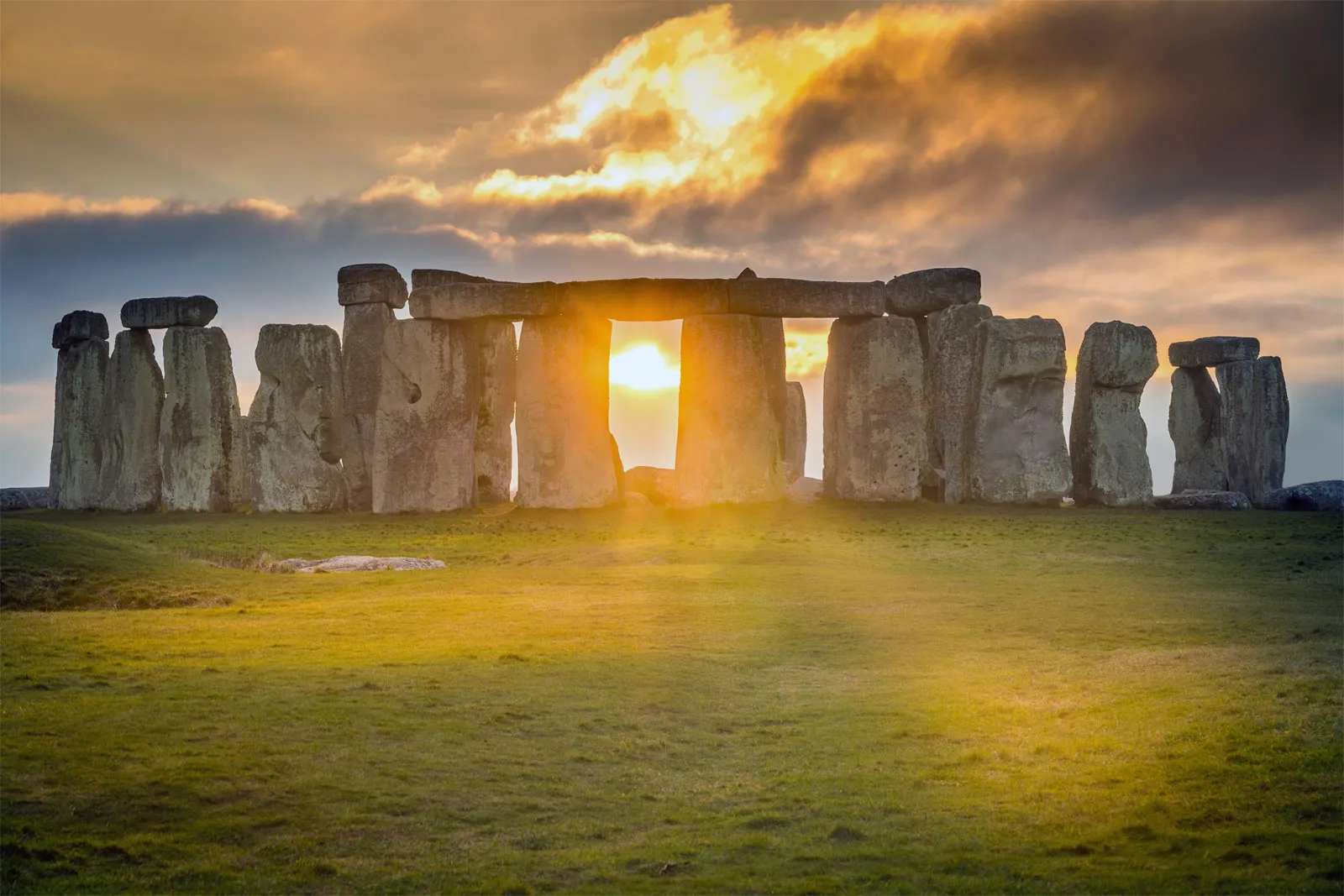
English Heritage states that Stonehenge was designed in relation to the solstices. On the summer solstice, the sun rises behind the Heel Stone and the first rays shine into the heart of the monument; the winter solstice is also built into its alignment. This strongly supports the view that Stonehenge was tied to seasonal turning points and ceremonial gathering.
Stonehenge is best understood not as a single isolated monument, but as part of a wider ritual landscape on Salisbury Plain. Its importance lies not only in the stones themselves, but in the relationship between monument, sky, season, and human community.
In that sense, Stonehenge remains one of the clearest windows into prehistoric British religion and ceremonial life, even if the full belief system behind it is now beyond complete recovery.
Druids and Celtic Spirituality
Centuries after many of the earliest stone circles were built, another spiritual tradition became associated with Britain and Ireland: the Druids.
Because Druids left little or no direct written testimony of their own, historians rely heavily on classical and later sources. Those sources describe Druids as religious specialists, teachers, philosophers, and custodians of ritual within Celtic societies, though the details remain debated.
What seems reasonably clear is that Celtic spirituality involved a close relationship between people and place. Forests, rivers, hills, seasonal cycles, and sacred groves all appear to have held spiritual significance in the traditions later associated with Druidic culture.
This historical uncertainty matters. It helps us avoid overstating what scholars know while still recognising that ancient British spirituality included profound forms of land-based meaning, ritual, and cosmological imagination.
Roman Rule and the Suppression of Druidic Tradition
The spread of Roman rule across Britain brought major cultural and religious change.
A key episode in later memory of the Druids is the Roman assault on Anglesey (Ynys Môn) in 60–61 CE, during the governorship of Suetonius Paulinus. Roman and later historical accounts present Anglesey as an important centre of Druidic influence, and Tacitus’ writings helped cement that association in later history.
Over time, Roman administration and later Christianisation transformed the spiritual landscape of Britain. Even so, older traditions did not vanish all at once. Echoes survived in seasonal customs, folklore, sacred wells, local legends, and the enduring presence of ancient monuments in the landscape.
This layered inheritance is part of what makes the spiritual heritage of Britain so compelling. It is not one single tradition, but a long conversation between land, memory, and cultural change.
Reconnecting With Britain’s Ancient Wisdom
Today, many people feel drawn to reconnect with the older sacred dimensions of the British landscape.
Stone circles, ancient pathways, sacred hills, and seasonal festivals still invite reflection on the relationship between people and place. Even where historical certainty is impossible, the sites themselves continue to inspire reverence, curiosity, and a sense that the land remembers more than we do.
Rather than treating these traditions as dead relics, the article can frame them as living invitations: ways of listening more closely to season, place, ancestry, and belonging.
Listening to the Land
The sacred landscapes of the British Isles remind us that spirituality often grows from the places people inhabit.
Stone circles, ancient earthworks, and old pathways still stand across the countryside, quietly holding memory in the land. Though centuries have passed, these sites continue to invite us to pause, listen, and imagine how earlier peoples experienced the turning of the year, the movement of the sun, and the mystery of being alive within a larger world.
At Soul Revolution Festival, that same spirit of curiosity and reverence continues.
Join us and rediscover the sacred heritage of these islands.